
Aztec Arrest Record Custodians
Aztec's county-seat status does not merge anything. Police, jail, and court files stay separate in San Juan County. Aztec Police keeps its incident records and monthly crime reports. The ADC holds the booking record after someone enters county custody. Courts take over the case next. District, magistrate, or municipal court each handle matters within their own jurisdiction. Keep those stages apart while searching. Carry a booking or docket number forward.
That split also explains a missing match. A citation leaves a police and court trail. But it creates no ADC booking. A fresh intake may lag before it reaches the public roster. A released person can vanish when the In Custody box is checked. Drop that filter and search again. Then ask the office that owns the exact record. Do not rely on a copied arrest page somewhere else.
How Aztec Arrests Are Recorded
Aztec Police Department writes the local incident and enforcement records. A booking entry appears only when the arrest leads to custody. The San Juan County Adult Detention Center creates that record. Its official ADC Detainee Inquiry is the county source for bookings. It shows current and past detainees, charges, bond fields, and custody status. Booking photographs appear there too.
Not every police action becomes a jail entry. A citation or release skips the ADC entirely. That record may still sit with Aztec Police. It may also rest with the court. A roster hit, meanwhile, only confirms intake happened. The arresting agency, charge wording, and booking date describe the arrest record at that stage. A later court disposition can read differently.
Where Aztec Arrest Records Appear
Aztec has no daily arrest roster or mugshot feed. Its police site offers contacts, monthly crime reports, a request form, and a crash-report route. Person-level county bookings surface through the ADC. Court tools then trace a docket once charges enter the system.
| Channel | Best use | Limit |
|---|---|---|
| San Juan County ADC Inquiry | Booking, custody, bond, charge, and photo information | Not a conviction record |
| Aztec Police Department | Incident report, officer record, city-held image | No complete public booking feed |
| New Mexico Courts | Docket and disposition research | Some cases or documents are restricted |
| Sheriff media releases | Selected incidents and agency statements | Not comprehensive |
| Local news and aggregators | Discovery and narrative context | Unofficial or selective |
Commercial sites copy an Aztec label, a charge, or a booking photo. Then they never update it. PublicJailRecords.com is one example. San Juan County expressly says the site is not affiliated or endorsed. Arrests.org carries city links for Aztec, while other commercial pages cover the county. None of them controls custody status. None shows a case outcome.
Find Someone Arrested in Aztec
The county form takes a name, subject number, booking number, booking-date range, custody choice, and housing facility. Its date field means booking dates. Nothing promises a refresh schedule. It is not a rolling 24-hour arrest clock.
- Search the ADC inquiry by full or partial name, using a booking-date range when helpful.
- Do not select “in custody” at first if the person may have been released.
- Compare the date of birth, housing facility, booking number, and custody indicator before opening a detail.
- Read the arresting agency, bond, docket number, charge rows, and booking history in context.
- When no booking appears, request the Aztec incident record or contact the issuing court about a known case.
A fresh intake may post only after processing finishes. One instant search proves little. Come back and recheck. The Daily Arrest Report explains how the same-date booking filter works. The county roster remains the source either way.
Someone who moves to state prison, probation, or parole later may show up in the New Mexico Corrections Department offender search. That state tool skips ordinary county detention. It cannot confirm a new Aztec booking.
Requesting Aztec Police Reports
The Aztec records request form cites the Inspection of Public Records Act as its authority. Submissions go to apdrecords@aztecnm.gov or fax (505) 334-7629. Copying costs $0.50 per page. Some content can still be withheld. The form points to confidential sources or methods, or a person accused but not charged.
A focused request gets routed faster. Give the person's name, the event date, and the location. Add a case number if known. State the exact record you want. For an officer narrative or a city-held image, name Aztec Police. For a booking sheet or intake photo, the county ADC is custodian. No agency must create a new compilation to answer.
The official Aztec Police page posts department contacts alongside its record links.
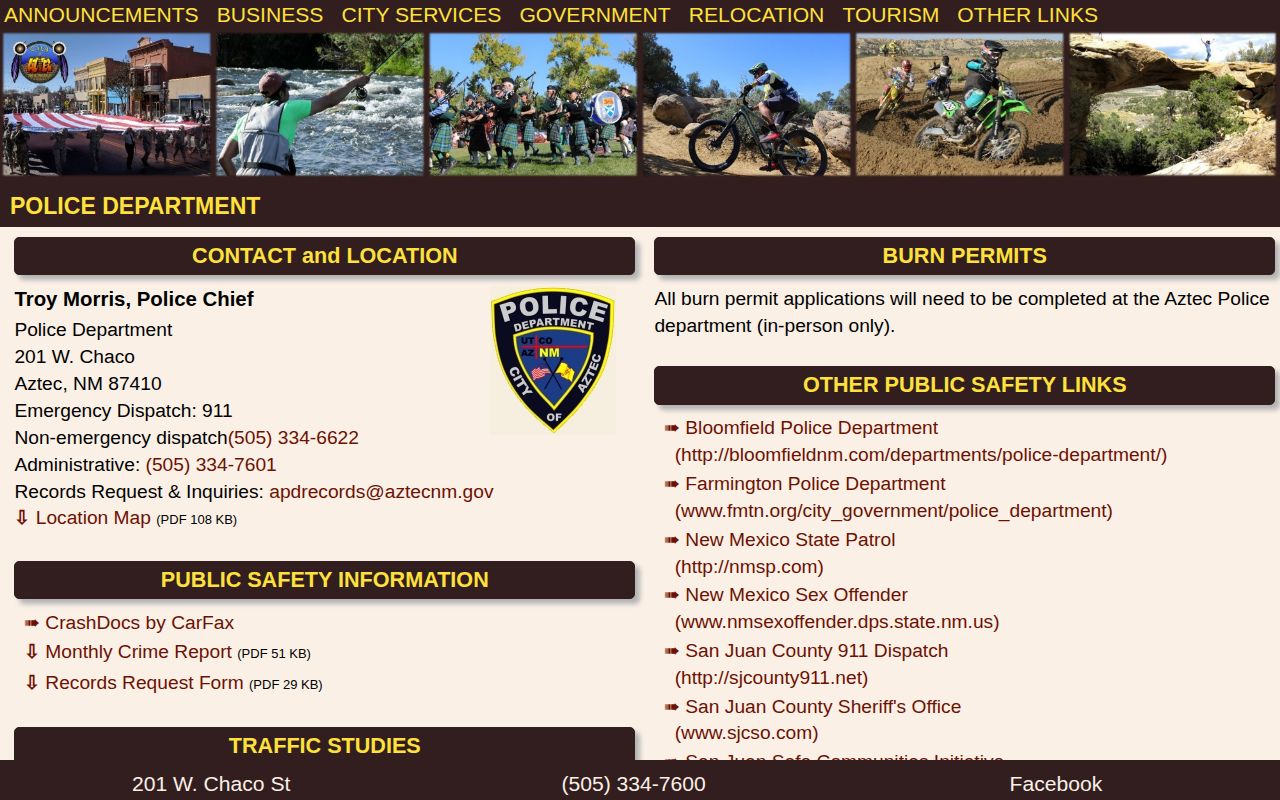
The image covers the city records route without showing any booking photo or detainee.
Aztec Police Department201 W. Chaco
Aztec, NM 87410
Administrative and records: (505) 334-7601
Non-emergency dispatch: (505) 334-6622
Emergency: 911
New Mexico's IPRA calls for a prompt response and never later than 15 calendar days. The clock is firm. If records cannot be produced within three business days, the custodian sends a written explanation with an estimated time. Redaction or an exception can still limit production.
Aztec Arrests and County Courts
Aztec serves as the San Juan County seat. That status puts the district and magistrate courts right in town, yet it does not create one public county warrant database. No official active-warrant search exists online. Anyone who knows of a warrant should contact the issuing court, a lawyer, or law enforcement. A booking detail on the ADC site can include a docket number along with later disposition fields. Carry that number into New Mexico Courts Case Lookup. Basic results are thin. Full case documents, plus juvenile, municipal, and sealed matters, rarely show up in a plain name search. The official court locator covers Aztec and Farmington contacts. It maps the city-to-court route plainly.
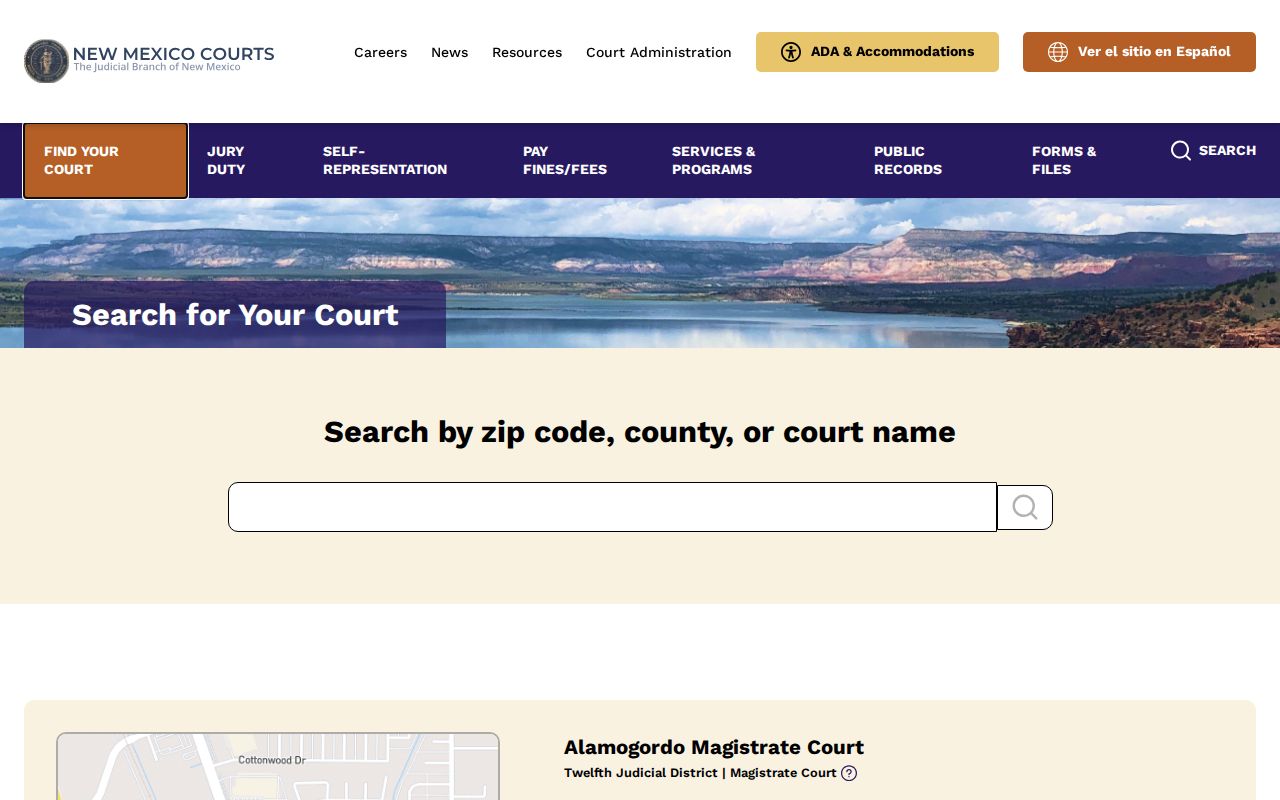
The courts handle what happens after an Aztec arrest, not a live county booking feed.
- Warrant
- A court order authorizing an arrest or requiring action in a case.
- Booking
- The jail intake process that creates the county custody record.
- Bond
- A release condition or amount set in connection with a case.
- Disposition
- The court’s final or later resolution of a filed charge.
Aztec Crime Reports Versus Rosters
Aztec Police posts monthly crime reports on its official page. Those summaries track city activity. They are not a county booking list. Nothing there shows everyone booked into the San Juan County ADC, so treat the numbers as city-level only. A reported incident may never lead to county intake.
The reverse holds too. The ADC receives people arrested by the sheriff, Farmington Police, Bloomfield Police, state agencies, and other partners. A roster entry might come from any of them. The arresting-agency field helps sort that out. Even so, the label alone does not confirm the reported charge. The official FMPO population table puts Aztec at 6,150 residents in the 2024 ACS five-year estimate. That scale cannot become an arrest rate without matching counting rules from a real source.
Aztec Booking Photos and News
The ADC is the official booking-photo channel once an Aztec arrest reaches county intake. One detail page can hold several bookings. Each may carry its own photo timestamp. Aztec Police may keep a different image inside its own incident file. Naming the exact image and date keeps city and county records straight.
Local news adds context. Tri-City Record publishes Aztec-area crime stories. The Daily Times, regional broadcasters, and the sheriff's media archive cover bigger events. These outlets name agencies, affidavits, and court events. None of them is a complete arrest roster, though. A photo in a story is one version only. It does not guarantee the same image sits on the current ADC page.
Third-party arrest sites can keep old copies long after a release or a record change. Start corrections with the agency or court that owns the fact. New Mexico has no special mugshot statute forcing independent sites to delete a copy. Expungement or sealing, where available, is an official court process. It never turns a private copy into a current government record.